There’s no right amount to spend on a wedding. What matters is picking a number you’re both comfortable with, before you fall in love with a venue.
Here’s how to set that number, split it sensibly, and keep track of deposits and balances so nothing sneaks up on you.
FreeEverything in this guide is free in Your Wedding HQ.
1. Start with what you can afford
Work out the total before you get quotes. Add up what you’ve saved, what you can put aside each month until the wedding, and what family members have offered. Ask anyone who’s chipping in for an actual amount, and whether it’s for anything in particular.
That total is your ceiling. Then decide together what matters most. If the photos are what you’ll keep forever, that’s where the money goes, and something else gets trimmed.
2. Split it across the big categories
Venue and catering usually take close to half of the budget, because every guest needs a seat, a meal and a drink. Here’s a typical split, worked through for a $40,000 wedding with about 100 guests:
| Category | Share | On $40,000 |
|---|---|---|
| Venue & catering | 48% | $19,200 |
| Photography & video | 13% | $5,200 |
| Flowers & styling | 8% | $3,200 |
| Attire, hair & makeup | 9% | $3,600 |
| Music & entertainment | 4% | $1,600 |
| Rings | 4% | $1,600 |
| Stationery | 2% | $800 |
| Celebrant & ceremony | 2% | $800 |
| Cake | 2% | $800 |
| Transport | 2% | $800 |
| Favours & gifts | 1% | $400 |
| Contingency | 5% | $2,000 |
At $40,000, that’s around $190 a head for the venue, food and drinks, enough for a mid-range package. The rings line covers a pair of plain gold bands. Platinum or diamonds can easily double it. Treat the split as a starting point: a small wedding at a family property spends far less on the venue, and a big guest list spends more on catering.
3. Track quotes, deposits and balances
Most suppliers take a deposit to hold your date and the balance a few weeks before the wedding. For each one, keep track of:
- the quote, then the actual price once you book
- what you’ve paid so far
- when the next payment is due
That’s also how you’ll spot overspend early. If the florist comes in $400 over, you can find that $400 somewhere else now rather than at the end.
4. Keep the budget in Your Wedding HQ
Your Wedding HQ’s budget tracker does the adding up. It uses the same categories and suggested split as the table above, in Australian dollars.
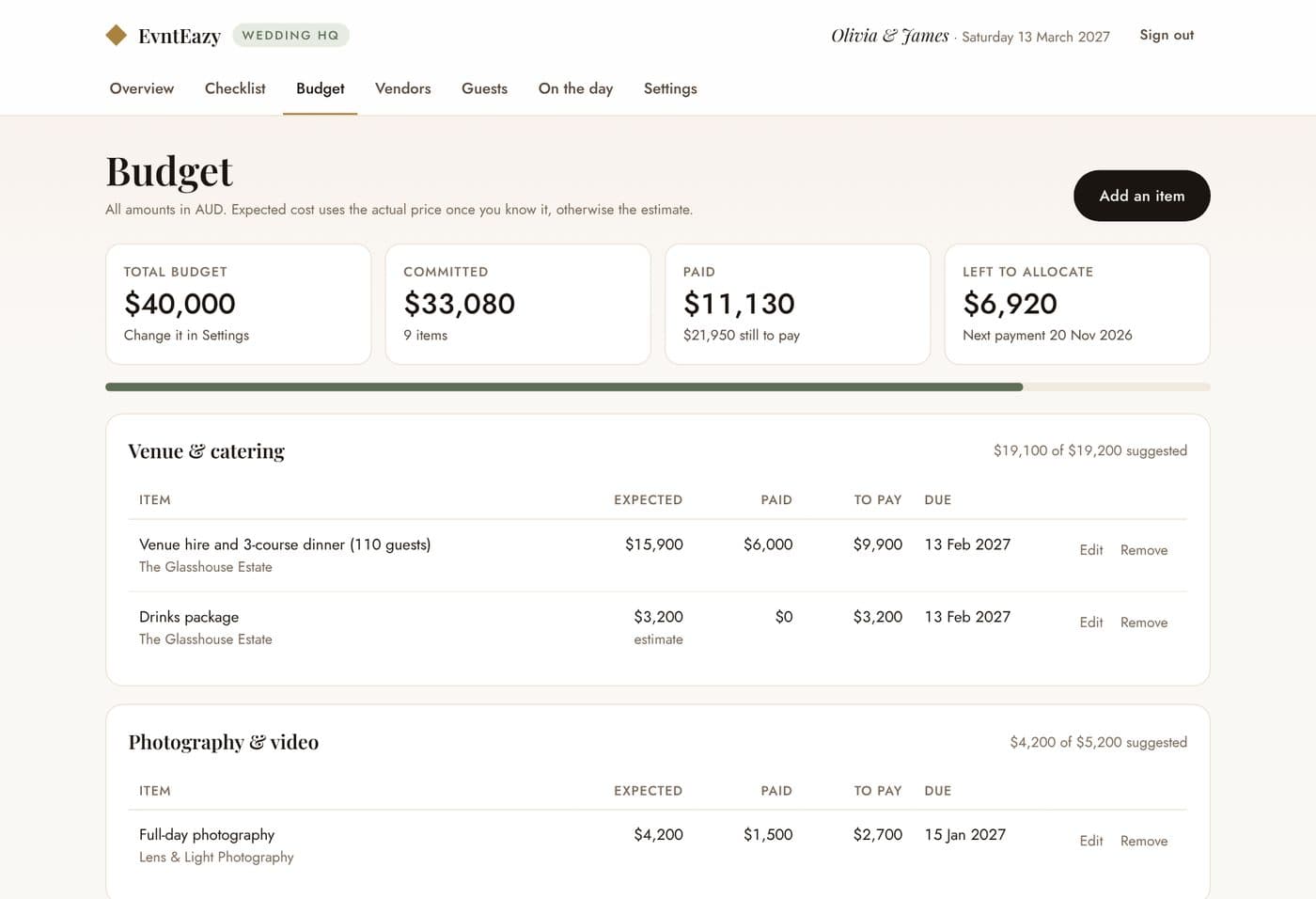
- Set your total budget in Settings.
- Add an item for each supplier as quotes come in: what it is, the category, the supplier and the quote.
- When you book, add the actual price, what you’ve paid and when the rest is due.
The totals across the top update as you go:
- Committed: what everything adds up to, using the actual price where you have one and the estimate where you don’t.
- Paid, and how much is still to pay.
- Left to allocate: your budget minus what’s committed. If you go over, it says Over budget and shows by how much.
- Next payment: the date of the earliest payment that’s due.
Each category shows what you’ve committed against its suggested share, and payments due in the next two weeks or already late are flagged. Your partner sees the same numbers, so there’s no “which spreadsheet is the latest?”
Prefer a spreadsheet for now? Our free wedding budget tracker template uses the same categories.
Plan it together in Your Wedding HQ
A shared checklist, budget tracker, guest list and run of the day, free forever. No credit card.